




Dry eye and trifocal lenses: when premium IOLs are the right choice — and when they are not

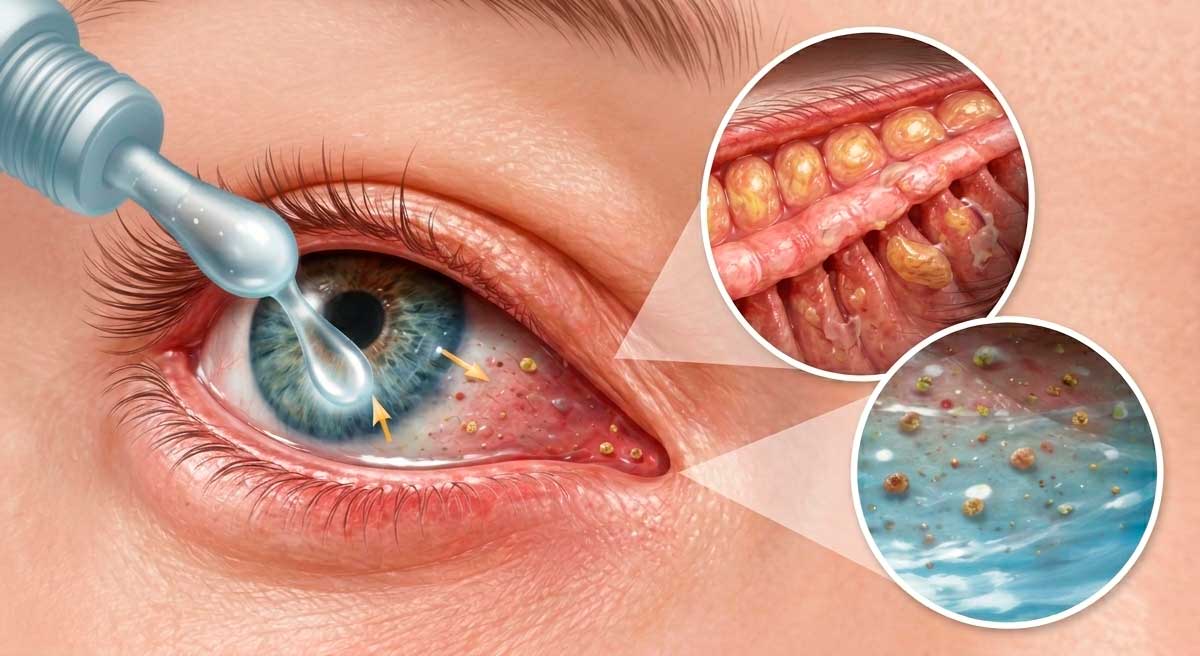
Dry eye and trifocal lenses: why not every patient is a candidate for maximum technology in cataract surgery
When patients consider cataract surgery or refractive lens exchange, the conversation often focuses on trifocal intraocular lenses and the possibility of becoming independent from glasses.
However, one critical factor is frequently underestimated: the quality of the ocular surface and the presence of dry eye disease.
The ocular surface: the eye’s first optical system
Before light reaches the cornea or the intraocular lens, it passes through the tear film.
The tear film is not just a lubricant — it performs key optical functions
- It is the first refractive surface of the eye.
- It directly influences optical quality.
- It determines visual stability.
- It conditions contrast and sharpness.
A patient may have good visual acuity during consultation, yet experience fluctuating vision throughout the day due to tear film instability. This becomes crucial when discussing trifocal or other premium intraocular lenses.
What happens if a trifocal lens is implanted in a patient with untreated dry eye?
Trifocal lenses distribute incoming light into different focal points to provide distance, intermediate and near vision, and they work exceptionally well when the optical system is stable.
An unstable ocular surface can cause:
- More noticeable halos
- Reduced contrast sensitivity
- Fluctuating vision
- More difficult neuroadaptation
Final satisfaction can decrease. This is not a problem of the lens — it is a problem of indication.
What do we do in these cases?
Before choosing the intraocular lens, we perform a specific ocular surface assessment.
We evaluate:
- Tear film quality and stability
- Meibomian gland function
This evaluation helps determine whether the eye is suitable for a multifocal lens or whether a safer optical strategy is preferable.
Sometimes, less technology means a better visual outcome
In several patients, a monofocal or enhanced monofocal lens offers greater stability, better contrast and a lower risk of dissatisfaction.
Even if reading glasses are needed, this option avoids worsening the patient’s current visual quality.
Our surgical criteria
My goal is not to implant the most advanced lens — my goal is to choose the lens that works best for your specific eye.
In cataract surgery, excellence is not about using the highest technology, but about selecting the right technology for each patient.
Learn more in our intraocular lens section
To book an appointment: https://soleyes.es/en/book-online/
Medical review
Reviewed by: Dr. Antonio Soler García, Medical Director at SolEyes Fuengirola.
Medical license number: 292907906.
Updated on: 2026-03-04.
Important notice
This content is informational and does not replace a professional medical evaluation.


