




Presbyopia Eye Drops: Reading Without Glasses Again?

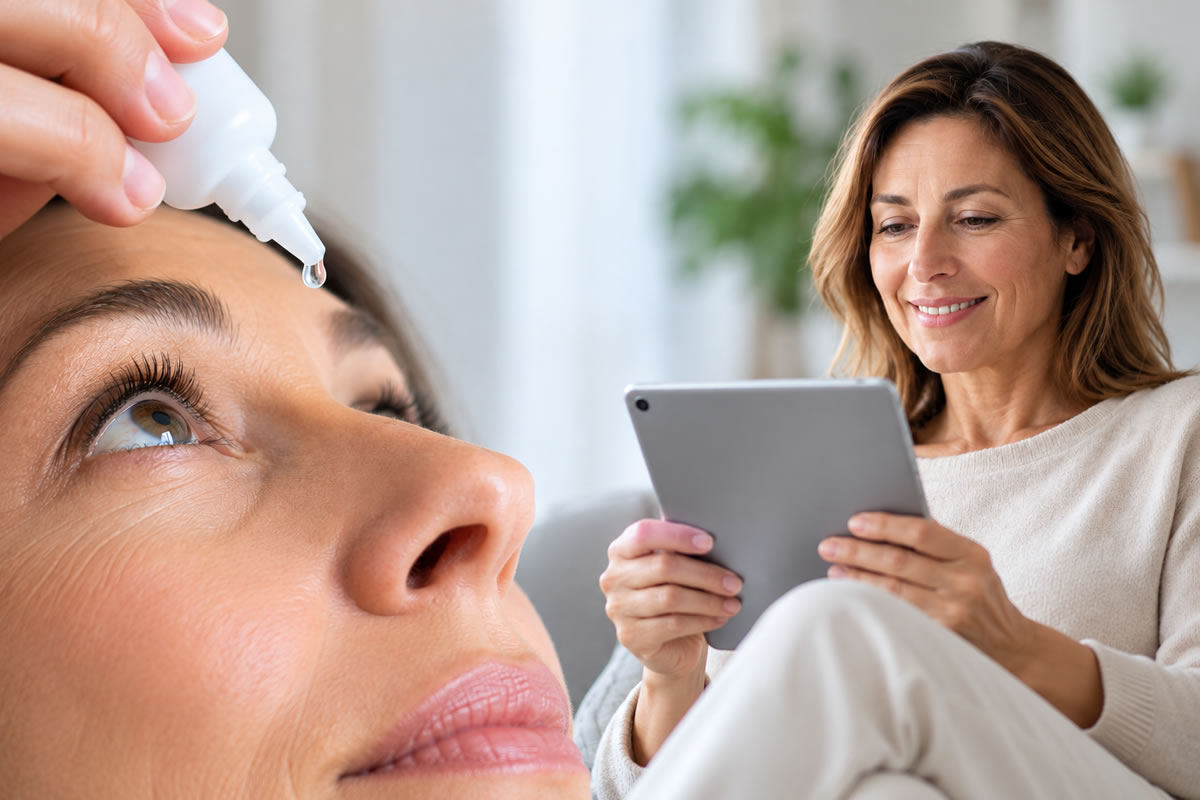
Presbyopia Eye Drops: Could We Read Without Glasses Again?
From around the age of 40–45, many people begin making an almost unconscious movement: holding their phone farther away in order to read it.
This is presbyopia.
For decades, the available solutions have been mainly optical or surgical: reading glasses, progressive lenses, contact lenses or, in selected patients, different surgical procedures.
In recent years, however, a completely different alternative has emerged: eye drops capable of temporarily improving near vision.
The obvious question is whether they really work.
The answer is yes, but with important qualifications.
Eye Drops for Presbyopia: Could We Read Again Without Glasses?
Why Does Presbyopia Develop?
When we are young, the crystalline lens can change its shape to focus on objects at different distances. This mechanism is known as accommodation.
With age, the system progressively loses this ability and focusing at near becomes increasingly difficult.
We initially need more light to read, then begin holding text farther away and eventually require optical correction for near vision.
How Can an Eye Drop Improve Near Vision?
This is the most interesting part.
Currently available eye drops do not restore the youthful accommodative ability of the crystalline lens.
Their principal mechanism is different.
Certain drugs produce a controlled reduction in pupil size. A smaller pupil creates an optical effect similar to reducing the aperture of a camera: it increases depth of focus.
Near vision can therefore improve while maintaining functional distance vision.
This is known as the pinhole effect.
The patient may read better, but the crystalline lens has not become younger.
Pilocarpine: The First Generation
Pilocarpine was the first drug approved by the FDA specifically for presbyopia.
Its efficacy is now supported by a substantial body of clinical evidence.
A meta-analysis published in American Journal of Ophthalmology included four randomised trials involving 1,531 participants.
- 33% of pilocarpine-treated participants gained at least three lines of distance-corrected near visual acuity.
- 12% of patients receiving vehicle achieved the same result.
- Improvement can be detected within the first hour.
- The effect may persist for several hours.
This demonstrates that the effect is not merely subjective.
The Limitation: Miosis Also Has Consequences
A smaller pupil increases depth of focus but also allows less light to enter the eye.
Some patients may therefore notice reduced visual quality in dim illumination.
Reduced Vision in Low-Light Conditions
A smaller pupil may compromise visual quality in poorly lit environments.
Headache
Headache is one of the most commonly reported adverse effects.
Blurred Vision
Temporary episodes of blurred vision have been reported in some patients.
Ocular Pain
Mild and transient ocular discomfort may occur.
There is another issue ophthalmologists must consider carefully.
Cases of vitreomacular traction and retinal detachment have been reported in temporal association with pilocarpine used for presbyopia.
This does not mean they are common, but it supports appropriate patient selection and particular caution in people with retinal risk factors.
Aceclidine: A New Generation
In July 2025, the FDA approved an ophthalmic solution containing aceclidine for treating presbyopia in adults.
Its particular interest lies in producing significant miosis with comparatively less effect on the ciliary muscle.
The available evidence includes:
- 466 patients enrolled in pivotal efficacy studies.
- 361 participants in a 26-week safety study.
- 883 participants included in a 2026 meta-analysis.
The pooled data demonstrate a significantly greater likelihood of improving near vision compared with placebo.
However, larger studies and long-term follow-up remain necessary.
Does This Mean the End of Reading Glasses?
No.
It is more accurate to regard these treatments as a new option rather than a universal replacement for spectacles.
Their effect is temporary.
Response depends on several individual factors:
- Age.
- Refractive error.
- Pupil size.
- Visual requirements.
- Individual ocular characteristics.
Some patients may find them useful for specific situations, while others will continue to prefer glasses.
Who Should Use These Drops?
These medications should not simply be viewed as drops to purchase and try without professional assessment.
Before using a drug that modifies pupil size, it is reasonable to understand the patient’s ocular status.
The peripheral retina deserves particular attention in individuals with:
- High myopia.
- Predisposing retinal lesions.
- A history of retinal disease.
Night-driving requirements and other situations demanding high-quality vision should also be taken into account.
Personalised medicine remains essential.
Are These Drops the Future of Presbyopia Treatment?
We are probably witnessing the beginning of a new therapeutic category.
For decades, presbyopia management focused on placing a lens in front of or inside the eye, or surgically altering the optical system.
Today, we can temporarily modify the eye’s own optics pharmacologically.
Research continues into treatments that are more selective, longer lasting and associated with fewer adverse effects.
However, perspective is important.
Current drops temporarily improve near vision; they have not been shown to reverse ageing of the crystalline lens.
Summary
Yes, eye drops capable of improving near vision in people with presbyopia now exist, and randomised clinical trials demonstrate genuine efficacy.
However, they do not cure presbyopia.
Their effect is achieved primarily by reducing pupil size and increasing depth of focus.
The real question may no longer be whether reading glasses will disappear, but whether we will be able to choose when we need them.
Frequently Asked Questions About Presbyopia Eye Drops
Can presbyopia eye drops replace reading glasses?
No. They may temporarily improve near vision in selected individuals, but they are not a universal replacement for reading glasses.
How do presbyopia eye drops work?
Most work by reducing pupil size, increasing depth of focus and improving near vision without reversing lens ageing.
What side effects can occur?
Reported side effects include headache, blurred vision, ocular pain and reduced visual quality under low-light conditions.
Are these drops suitable for everyone with presbyopia?
No. An ophthalmological evaluation is recommended to assess retinal health, visual requirements and individual risk factors.
Do presbyopia eye drops cure age-related near vision loss?
No. They temporarily improve near vision but do not restore the youthful accommodative capacity of the crystalline lens.
Medically Reviewed Content
Content written and reviewed by Antonio Soler, ophthalmic surgeon and Medical Director of Soleyes Eye Clinic.
This article is provided for informational purposes only and does not replace an individual medical consultation. Every patient requires a comprehensive ophthalmological evaluation before deciding on the most appropriate treatment.


